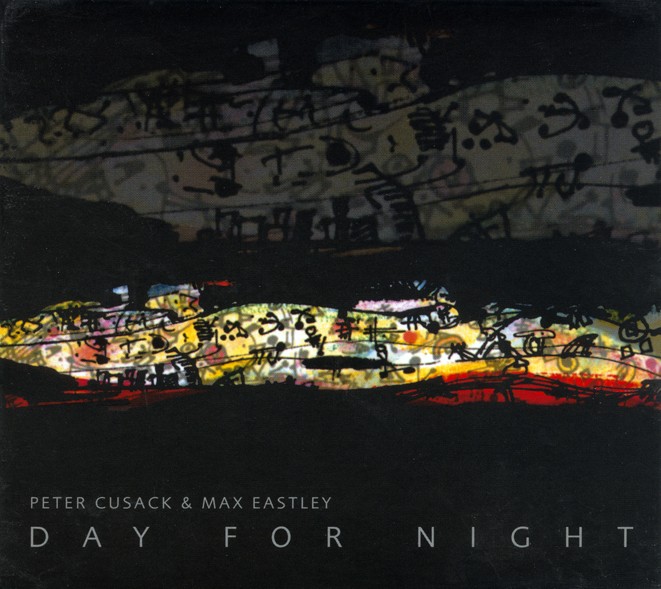
Day For Night


- Peep show 9:3
- Day for night 8:05
- Zero day to zero night 4:54
- Cast 5:05
- Roomshine 4:52
- Arc light 1:42
- Shade 1 3:12
- Shade 2 3:33
- Nest of wasps 6:23
ALLMUSIC
This CD represents a 25-year collaboration between renowned British avant-garde improviser Peter Cusack and instrument builder and sculptor Max Eastley. Cusack and Eastley have made these short episodes together between busy careers recording experimental music alongside artists such as Nicolas Collins, Steve Beresford, and David Toop). With numerous releases on ReR and Incus, the two musicians are mainstays of the British improvised music world, and Eastley is particularly prominent for his work with Toop in the '70s on Brain Eno's Obscure label -- which debuted his self-designed electro-acoustic instruments. Said instruments are highly developed kinetic sculptures powered by a range of forces from small engines to the wind or running water. The duo creates intriguing delicate compositions with these instruments, abetted by the transformed string instruments and electronics of guitarist Cusack, whose guitar is at times so far removed from its traditional use that it is hard to still call it a guitar. (Skip Jansen)
MOTION
With the popularity of the opening Peep Show on mainly european radio stations Day For Night happened to come together bringing with it 25 years worth of collected sounds dating from 1975 to 2000 by "favourite sound" archivist Peter Cusack and sound sculpturist Max Eastley. The title, Day For Night, is taken from a filming technique whereby, as Eastley explains, "You put a filter over the camera during daytime and it looks like night". This process also conjures up other notions; the way in which one can enjoy the experience for example, "I think some of the tracks are very tangible and some are very much interiors to do with the mind, you know, sort of spaces with which you can use your imagination." The preluding Peep Show, as the title suggests, provides a fleeting glimpse into a collection of sounds that exist in separate sonic worlds. Opening with a harmless bonfire night, the mechanism of an old brass clock (without the chime) winds itself up, opening our anticipations to a collection of other fascinating sounds as varied and as rich as you can hope for: broken glass being brushed along inside a 5,000 square foot area with a clean electic guitar waterfalling down through the whole space; stretched elastics ripping through fresh forest air. The track acts as an excellent prelude to pure, raw and hardcore sounds. Sounds that would take 25 years to compile. Sounds that people might not hear in a lifetime. And within the remaining tracks we are not let down neither in terms of density of structure nor richness and variation of sounds: rotting carcasses with deers barking a Lord of the Flies soundtrack; Japzenlike made instruments warming wind into spiritual bliss; the ferocious sub-bass inside a nest of wasps. This is nature cranked up to 11. Purposefully underexplained in the sleevenotes each new listen awares the listener to new things taking place making this disc a real stodger. Played in your home it seems to bring the outside in. As Eastley states, "Some of the tracks are landscapes and obviously some are interiors". review by (Cormac)
NOISEGATE 11
Recorded at various locations between 1975 and 2000. Sound sources used, aeolean harps, ghetto blaster, cassette machines, broken glass, electro acoustic monochord, fire, centriphone, guitars, bouzouki, humming tops, environmental and wildlife recordings, buzz disc. Kids, fireworks. I had to give it a number of listens before I began to really appreciate this recording.
Begins with the typical sounds of a Mediterranean festival, the bazouki implies it's in Greece, or it could be north London. Cuts, crash, broken glass. The sounds switching quickly in places like scenes in a film, your mind putting in the visuals. You're in a forest, sitting around a fire, an animal is barking, a fox maybe, birds singing, something is about to happen? You're now in a factory, moody, melancholy. Protestors going home after a demo, blowing their whistles, someone's trying to start their car, there is a musical undercurrent at times, the monochord, with band saw, dark chilling. Surface scratching, trains slowly rattle down a line. A field, hazy sunny day, bees occasionally fly up close around your head, aeolean harps, electronic. Dreamlike, ideal, unreal, poetic. (Paddy Collins)
OPPROBRIUM
This comes in a lovely fold-out digipack cover. The sounds are processed audio verite. You know the drill: small-town firecrackers, 'Granchester Meadows' fly buzzing lazily around, night-time campfire with various species of birds in attendance. At other times you will hear quasi-Xenakisian transforms of breaking glass and metallic sounds (could they be... [hushed pause] bowed cymbals?). It's all very likeable - perhaps nothing you haven't encountered before, but who cares? If you like this sort of thing, you will find this a very good example of the "genre", worthy, even. (Brian Doherty)
SONOMU
With the popularity of the opening Peep Show on mainly european radio stations Day For Night happened to come together bringing with it 25 years worth of collected sounds dating from 1975 to 2000 by "favourite sound" archivist Peter Cusack and sound sculpturist Max Eastley.
The title, Day For Night, is taken from a filming technique whereby, as Eastley explains, "You put a filter over the camera during daytime and it looks like night". This process also conjures up other notions; the way in which one can enjoy the experience for example, "I think some of the tracks are very tangible and some are very much interiors to do with the mind, you know, sort of spaces with which you can use your imagination."
The preluding Peep Show, as the title suggests, provides a fleeting glimpse into a collection of sounds that exist in separate sonic worlds. Opening with a harmless bonfire night, the mechanism of an old brass clock (without the chime) winds itself up, opening our anticipations to a collection of other fascinating sounds as varied and as rich as you can hope for: broken glass being brushed along inside a 5,000 square foot area with a clean electic guitar waterfalling down through the whole space; stretched elastics ripping through fresh forest air. The track acts as an excellent prelude to pure, raw and hardcore sounds. Sounds that would take 25 years to compile. Sounds that people might not hear in a lifetime.
And within the remaining tracks we are not let down neither in terms of density of structure nor richness and variation of sounds: rotting carcasses with deers barking a Lord of the Flies soundtrack; Japzenlike made instruments warming wind into spiritual bliss; the ferocious sub-bass inside a nest of wasps. This is nature cranked up to 11.
Purposefully underexplained in the sleevenotes each new listen awares the listener to new things taking place making this disc a real stodger. Played in your home it seems to bring the outside in. As Eastley states, "Some of the tracks are landscapes and obviously some are interiors". (Cormac)
VITAL
Max Eastley is one of those of names that everybody knows, but whose recorded output is not exceptionally high, at least not my knowledge. He's mainly known for his visual installations in which image and sound are incorporated. I have never seen any, so I can't comment. Peter Cusack worked with a lot of London's finest such as Clive Bell, David Toop, Beresford and helped setting up the LMC. According to the sleeve this CD was recorded in the course of no less than 25 years and it sources include: aeolean harp, ghetto blasters, broken glass, fire, guitars, wildlife recordings and more of this. Eastley's installations seem to be the backbone of the nine pieces, but a piece like 'Peep Show' seems to me be entirely made of environmental sounds. The title piece on the other hand seems to be just sounds from an installation. Of course I might be mistaken. I don't think it's really important. The music is of delicate beauty, small and vulnerable. You are time warped through time and space - from the urban jungle to forest and back in no time. There is one thing however I don't understand: why it took so long to make this CD. It's hard to see for me why it took them 25 years. It's a very very good CD, but 25 years...? I hope the next one will arrive sooner. (FdW)
The WIRE (March 2001)
Peter Cusack and Max Eastley's work together over the last 25 years has largely been invisible. Indeed, this is the first recorded manifestation of their collaboration. Here, the wild card improvisor Cusack contributes environmental recording skills, leaving his MIDI-bouzouki and acoustic guitar behind, while visual artist and musician Eastley brings his invented instruments (many designed to be played either by the natural environment - streams, the wind - or tiny electric motors) and occasionally his arc (a bowed one string instrument processed with live electronics). The beautifully designed sleeve (adorned with Eastley's artwork and a photgraph of him and Cusack disappearing into a thicket of bracken and heather) arms us only with the slight epigraph: 'Recorded at various locations between 1975-2000'. This leaves us to wonder about the motivation behind these recordings: Are they the traces of acts of poetic terrorism in the wilderness? No information is given about their sound sources. They're obvious enough on 'Peep Show', a kind of audio film which alternates sound events of a macro scale (firework displays, brass bands) with those of a micro scale (bees, small instrument improvisations, footsteps in shingle, spinning tops), marking their juncture with the audio equivalent of short, sharp slaps. On 'Shade', the sound of a train fades in and out of the driving rain as if mirroring the drift of consciousness between inward and outward attention. 'Zero Day To Zero Night' features crackling wood fire alongside the night calls of birds and animals - was this remarkably full soundfield a multitracked construction or a naturally occuring event? Elsewhere recognisable sounds rub alongside those of unknown origin. 'Cast' could be opencast mining noises merging with feedback, while the title track might derive from objects rattling around the inside of metallic bowls. If the act of naming is a kind of closure giving an excuse to stop listening, then these powerful yet evanescent recordings let sound, in all its natural wonder, delicacy and complexity, speak for itself. (Phil England)